
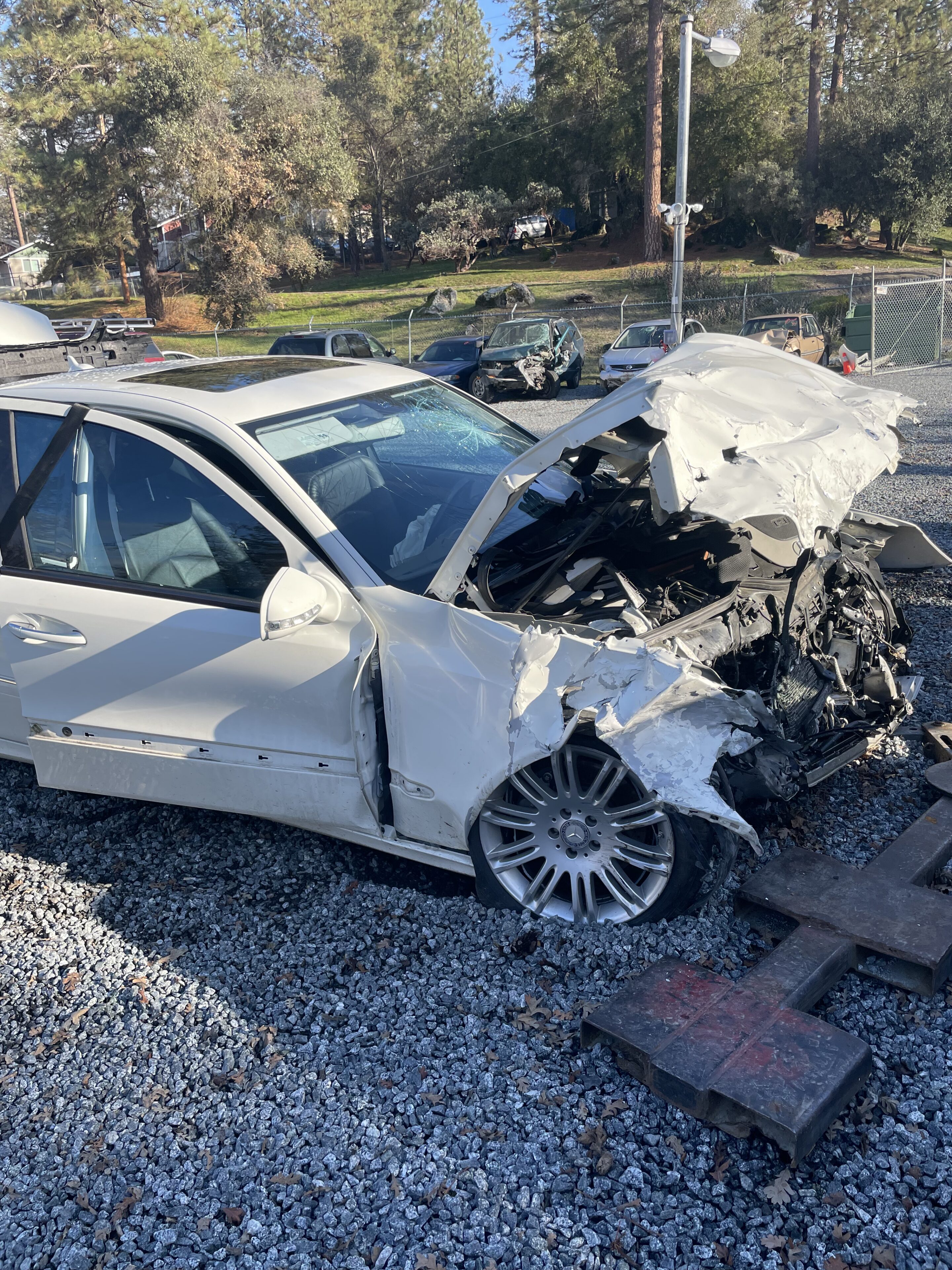
From head-on impact to hard-won hope: Lisa Carisio’s long road back
On the evening of Jan. 1, 2024, what began as an ordinary drive along Highway 49 became the dividing line in Lisa Carisio’s life: before the crash, and after it. Carisio was driving north between Oakhurst and Mariposa, near Nippinawassee, with her daughter in the passenger seat when she rounded a curve near Road 601 and saw headlights coming directly toward her in her lane.
“At the apex of the curve I saw headlights traveling toward me,” Carisio recalled. In the split second before impact, she said, she checked the road position of her own vehicle and saw that she was inside the double yellow line. The oncoming vehicle, she said, was farther into the northbound lane. “The only possible reason for this other vehicle traveling south in the north bound lane, I presumed, would be to turn into Road 601.” Moments before the vehicles collided, Carisio pulled left, a decision she believes changed the trajectory of the crash and the path her body and her daughter’s body took inside the car.
The impact was violent and immediate. The engine compartment of Carisio’s 2008 Mercedes was forced underneath the vehicle. Her car seat sheared from the floor. Her legs, knees, thighs, pelvis, chest, neck and skull absorbed the force. She suffered multiple lacerations and contusions, an acute ACL tear, bilateral quadriceps tears, injuries to her skull, neck and chest, a crushing injury to the pelvis, and sprains to her ankle and wrist.
But in the first moments after the crash, Carisio’s attention went not to her own injuries but to her daughter Dee. “Directly following the impact, I found my daughter’s upper body was folded over the center console in my lap,” she said. Her daughter was incoherent, convulsing and bleeding. Carisio tried to lift her back into the passenger seat. Twice, she said, she could not get her daughter upright enough to inspect her injuries.
Thinking she could get out, circle the car and reach her daughter from the passenger side, Carisio opened the door and swung her legs out. They would not hold her. She fell to the pavement, suddenly farther from the child she was trying to protect. Other drivers arrived at the scene. Tires screeched. A man shouted for her to get out of the road. Carisio flipped herself over and used her arms to drag her body to the curb.
From there, she watched strangers help her daughter. Her daughter was breathing and mumbling when responders placed her on a gurney and moved her toward the ambulance. When firefighters and EMTs came for Carisio, her legs still would not support her. They carried her to the ambulance, where she pulled herself backward up the steps using her arms and settled near her daughter. “I consoled her and encouraged her to rest and pray each time she gained consciousness,” Carisio said.
Between tragedy and hope: Surviving the kind of crash that often turns fatal
Head-on crashes are among the most severe collisions on American roads. The Federal Highway Administration has reported that vehicle head-on collisions are the most harmful event in about 14 percent of all U.S. traffic fatalities each year and 27 percent of roadway-departure fatalities. In other words, while national data do not present a single simple “survival percentage” for every head-on crash, federal fatality data underscore how often these crashes become deadly. Carisio and her daughter survived, but survival did not mean the end of the damage.
At the hospital, Carisio remained focused on her daughter’s condition. Because she was transported in the same ambulance, she was taken to Valley Children’s Hospital. Medical workers evaluated her for acute injuries and considered transferring her elsewhere once they determined she did not have an immediately life-threatening condition. Carisio refused. Her daughter’s injuries had not yet been fully determined, and doctors were concerned about facial fractures and possible cervical spine fractures. Her daughter moved in and out of consciousness, and after morphine, Carisio said, she became delusional.
“I refused to leave my daughter’s side,” Carisio said. She was discharged from emergency care between 1 and 2 a.m., but hospital workers allowed her to remain on a gurney beside her daughter until the girl’s father arrived from Kentucky the following night. “By their grace,” she said, “they gave me aspirin and helped me with a bedpan.” With two ace bandages, naproxen and essential oils from her purse, Carisio began trying to tend to her own knees while staying near her daughter.
The morning after the accident, Carisio spoke by phone with her personal physician. After reviewing the nature of the injuries and emergency room testing, she said, he understood her decision. In that situation, she said, he agreed he would remain at his own daughter’s side and postpone further self-care.
By the time her daughter’s father arrived, Carisio’s knees were swollen and barely mobile. She declined a transfer to another emergency room and returned home with family. Waiting for her were a borrowed wheelchair and a bedside commode. What followed was not a single recovery plan but a web of home care, alternative therapies, clinical visits, pain management and daily improvisation.
A nurse practitioner came to her home to check her vital signs and assess the risk of thrombosis from damaged tissue in her legs. A massage therapist performed lymphatic drainage. A naturopath prescribed remedies and supplements. An essential oil consultant applied oils intended to reduce swelling and pain. A chiropractor came to adjust her knees, lower back and neck.
“Every part of my healing process happened here in Mariposa. I saw every type of healer I could find and eventually spent about $50,000. I think I’ve come out with a better performing body that when it happened. I had Scoliosis and old knee problems before the accident,” Lisa shared.
“Just two weeks before the accident I was sitting in my office thinking ‘how can I spend more time working on these issues.’ It’s like God said, you want me to help you get serious about this? There are other pieces of this story about how God was working in our lives that have just been incredible,” Carisio added.
As Carisio regained the ability to navigate the steps of her porch, she began receiving rides to town for chiropractic care, massage therapy, acupuncture, craniosacral work, strain-counterstain therapy, emotional release support, TAPAS lessons and Reiki.
The progress was slow and uneven. After weeks of therapies, Carisio could drive an automatic vehicle into town, but she could not straighten her legs to walk. She could press the gas and brake pedals but could not balance reliably. She could not stand to pour milk, put away dishes or cook a meal. She relied on a walker and sometimes a wheelchair. At night, she remained dependent on the bedside commode because she could not safely make it across the hall to the bathroom.
“I suffered flashbacks, insomnia, and restless legs at night for many months,” she said. Four weeks after the accident, vertigo appeared, which she associated with striking and breaking the windshield with her forehead. Her therapists also identified pelvic instability, nerve disruption behind and beneath both knees, and quadriceps damage that affected the position of her kneecaps and the mechanics of her gait.
By March, Carisio began working part time, two to three hours a day. Even that limited return came at a cost. Her knees swelled by midafternoon. Her calves ached and spasmed as she balanced near her chiropractic table. Constant pain affected her appetite, and she lost weight. As a chiropractor herself, she estimated that her early professional capacity was sharply reduced in strength, balance, speed, technique and endurance.
Still, small milestones accumulated. A borrowed stationary bicycle helped her move swelling and stiffness from her knee joints. She transitioned from wheelchair to walker, from walker to cane, and eventually used the cane only when terrain or distance was uncertain. She began using SOMA therapy and Gua Sha to address scar tissue and fascial alignment. She pursued homeopathy, private Pilates, Ayurvedic practice and formal ballet barre work in the effort to rebuild function.
The return to ordinary movements was emotionally significant. She could use the stairs at home, do laundry and access an infrared sauna. She could stand long enough to pour milk into a cup and carry it to the table without spilling. She could put away dishes and babysit. During spring break, she took a vacation with her daughter and walked on the beach with her cane.
But setbacks continued. In July, an inflammatory response connected to diet caused what Carisio described as almost unbearable pain in her already damaged knees. “WORSE than the initial pain of the accident!” she said. The flare-up cost her work and capacity, and minor recurrences followed into the fall. A moderate exacerbation caused more lost work in December.
By September, she realized at the fair how far she still had to go. She could barely reach the places she wanted to go. So, she started distance walking, initially a quarter mile at a time. A Jazzercise reviewer who was also a physical therapist gave her pointers for balance, and after a probationary period Carisio was approved for modified low-impact teaching.
Thirteen months after the crash, on Jan. 31, 2025, Carisio had her first night of sleep without knee pain. By May, she could finally straighten her left knee and ankle at the same time. With focused attention, she said, she could approach a normal gait. Even so, she continued to suffer severe daily pelvic pain and ongoing complications from scar tissue, pelvic injury and inflammation.
For Carisio, the physical toll is only part of the story. The accident also changed her family life, her work life and her sense of herself as a mother. “What is not imparted is the social and emotional injuries this accident has caused,” she said. When her daughter came home, Carisio said, she could not “mother” her in the way she wanted. She could not tend to her daughter’s injuries, console her, provide financially, or make her feel secure about the future.
“I was stuck in a wheelchair and then stuck with a walker,” she said, adding that she could not simply keep up at the grocery store until 10 months after her daughter came home. “Not being able to ‘mother’ my daughter when she needed me has completely changed the dynamics of our relationship. I have lost confidence in my authority and influence.”
Her daughter was hospitalized for four days, and she’s two facial surgeries, and other treatments tht lasted weeks after the accident. “We were worried that her eye wouldn’t look right, but it’s perfect. She had an injury to her other eye when she was an infant, and this made her eye match. They are kind of squinty, but perfect. We had a lot of psycological trauma after it. My daughter saw a counselor for a long time afterward. She was 15 and a half years old when it happened.”
Dee told me, “You know, I thought driving was going to be all about me, but now I see someone’s else’s error can completely ruin you day” her mother explained. “She’ll be 18 in October and she’s moving forward toward getting her license. It’s taken a long time for both of us to stop worrying about other people driving toward us,” Lisa recalled.
Her relationship and household also changed. Cleaning went undone. Landscaping, garden plants and office plants were lost. Food sensitivities complicated family meals. Pain interrupted sleep and kept her from sharing normal routines with her partner. The lingering pelvic injuries, she said, continued to affect intimacy and daily comfort long after the visible signs of the collision had faded.
Lisa came to Mariposa when she was three years old. She graduated from Mariposa County High School in 1991, and on a scholarship received a degree in Integrated Biology from U.C. Berkley. From there she went to Palmar Chiropractic College in San Jose and graduated three and a half years later. Carisio opened her successful chiropractic office in Mariposa in 1998, where she’s treated countless local residents for years.
The story of the crash is therefore not only a record of impact, injury and treatment. It is the story of a mother who crawled from a roadway, stayed beside her injured daughter, and then spent the next year rebuilding the most basic movements of daily life. It is a story marked by pain, but also by endurance: the first step after a wheelchair, the first walk on a beach with a cane, the first night without knee pain, and the first glimpse of a gait that once again felt close to normal.
Comments