
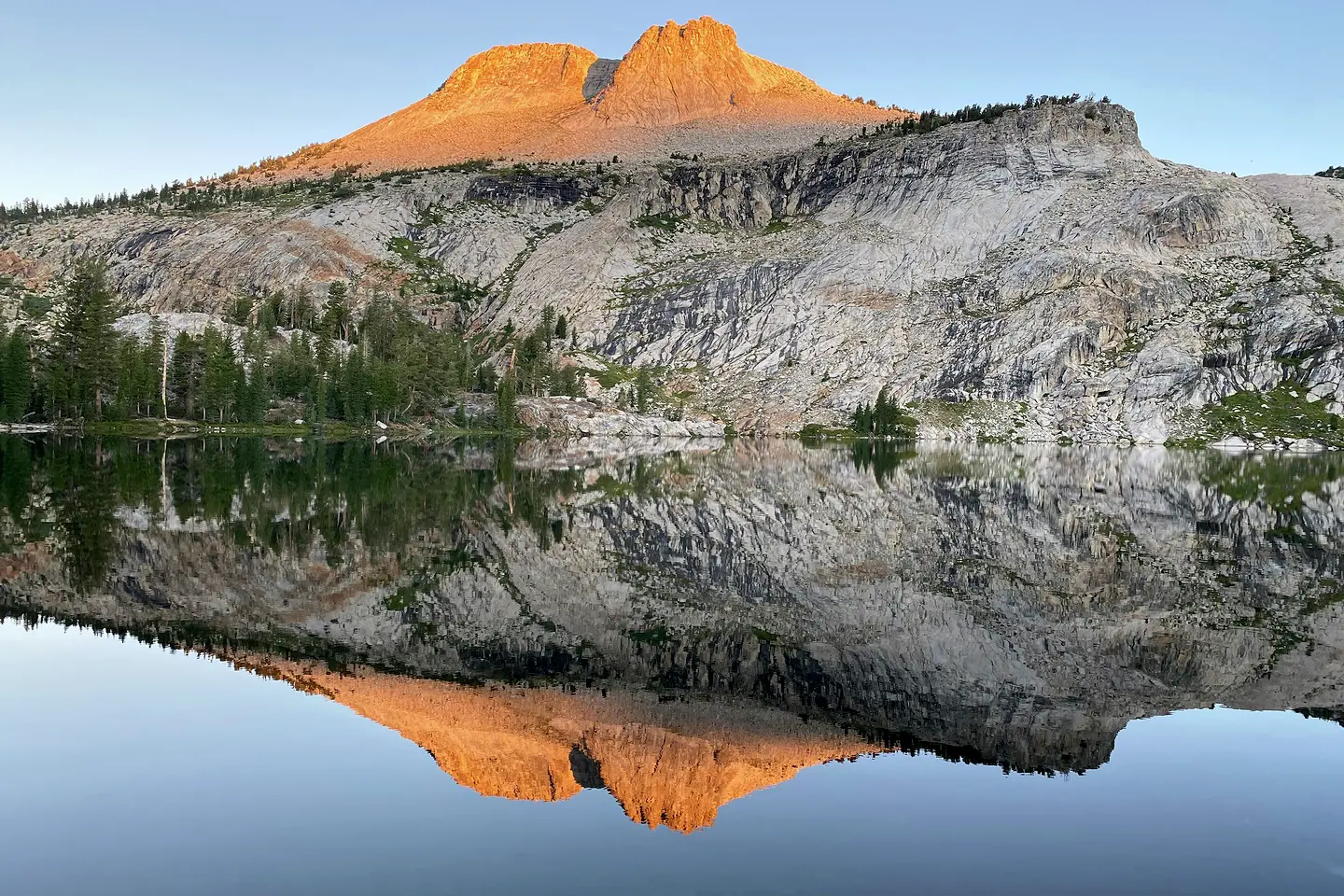
I went to Yosemite’s famed backcountry glamping spot. It kicked my butt.
The park’s century-old, hut-to-hut hiking trip has many highs and lows.
By David Curran, Audience Desk Editor
(Republished from SFGate – sfgate.com)
When I was told that Yosemite National Park’s High Sierra Camps were a glamping experience, I was a little taken aback. In my naivete, I had thought the word “glamping” suggested an experience you might consider actually “glam,” like staying in an Airstream or relaxing in Adirondack chairs set up around a perfectly arranged campfire ring, kind of like a Restoration Hardware catalogue in the woods.
But after waiting for years to embark on this historic hut-to-hut backcountry trip, this summer I learned the truth: Glamping can also include extremely unglamorous days of complete exhaustion, broken toilets, food shortages, missing signage and sleepless nights with strangers who somehow snore for seven hours straight.
Yet, while at times a sleepless slog, these were also among the most delightful four days in the backcountry I’ve ever experienced.
A waiting game
I first became interested in Yosemite’s High Sierra Camps years ago, but being able to go has been another, rather long, story. While they’ve existed for over a century, their recent history has been fragile.
For the six years before 2024, they weren’t open at all due to massive winter storms and the pandemic. Just three of the camps opened in 2024, but in 2025, all the camps shuttered again based on decisions by the National Park Service and its concessioner, Yosemite Hospitality.
Two of the camps — Vogelsang and Merced — remain closed this year due to major weather damage and sanitation challenges. And on top of all this, there are those who want the camps permanently closed due to the damage they inflict upon the environment.
Oh, and you must enter and win a lottery to visit them because they are extremely popular. It’s no secret why: You’re able to explore the Yosemite backcountry while carrying only a rucksack (15 or 20 pounds), sleep in tent cabins and be served two hot meals and a bag lunch each day. For an aging backpacker in mediocre shape — aka myself — this sounded like a dream. So, my wife and I entered the lottery for the summer of 2024. And, we won.
But then our 2024 trip got canceled because of a late opening due to a heavy winter. So we were promised a spot for 2025, but that fell through due to the whole season being canceled.
So here we were in 2026, finally ready to hit the trail. And it actually happened.
But first, a lodge
We went with another couple, and the four of us stayed in a standard tent cabin big enough for four twin beds, a little wood stove, complimentary firewood and mattresses soft enough to resemble sleeping in a marshmallow.
Here, you eat at the lodge, also a restaurant for the public, where the young servers are all very pleasant as they tell you about the day’s specials, as well as the items they’ve run out of, which can be pretty extensive. So don’t be heartbroken if there are no cinnamon rolls, tomato juice or chilled grapefruit, which happened on our morning there.
Then again, who cares if the supply chain is not on par with your local diner? The food here was tasty, with pancakes as big as your face and bacon that came in heaps. Plus, you hopefully don’t go to Yosemite for an order of chilled grapefruit. If you do, you might try the Denny’s in nearby Oakhurst.
Our trip began at Tuolumne Meadows Lodge in late July. This is a common starting point before heading to the backcountry camps, as it gives people a chance to acclimate since the hiking starts at around 8,300 feet and goes as high as 9,700. It’s also a nice introduction to the High Sierra Camps, where you can see what your $200 per night per person gets you.
Sierra Shangri-la
The White Cascade on the Tuolumne River is a roughly 50-foot waterfall that sits next to the Glen Aulin High Sierra Camp in Yosemite National Park, Calif.
David Curran/SFGATE
The next morning, we set out for our first destination, the Glen Aulin High Sierra Camp. It’s a meandering moderate hike that begins in Tuolumne Meadows and roughly follows the Tuolumne River to the northwest. The trail is not too busy, but it is very well marked, letting you know you’re still in one of our nation’s most popular national parks. It is also a far cry from the chaotic scene you can expect in Yosemite Valley.
In the meadow, the river is so slow it sometimes looks still, and it sets a tranquil tone. But there’s a point where a roar of the current announces that cascades are near. And this part of the trip, as you pass next to the powerful Tuolumne Falls, brings you to Camp Glen Aulin.
First, you see the White Cascade, spectacularly strong the day we arrived due to recent rains. And right below in the water, people are swimming in a wide pool like some high-altitude Shangri-la. Then, you cross a bridge over the river and another over a neighboring creek and arrive at the camp.
Camp Glen Aulin has been at this location since 1927. First built a little farther down the river in 1923, it was moved to its current location due to mosquito issues. The name means “beautiful glen or valley,” and it easily lives up to that.
Set in a glade of pine trees, the camp is compact and feels like a world apart, one that has somehow endured here for 99 years. There is nothing for miles in any direction. We pass the turnoff for the camp for backpackers — some who are walking the Pacific Crest Trail — and head to our first stop, the small office/dining hall. Here, a staffer named Chase welcomes us, gives us the bear box rundown, tells us which toilet is broken and describes an epic swimming hole five minutes away. We ask what’s for dinner, and he screams about 20 feet across the dining hall to the kitchen.
“Hey, Diego, what’s for dinner?”
“I don’t know! Beef!”
It is beef indeed. The food in these backwoods camps is served family-style, and onto our table that night comes a platter of steak that is mounded so high it could feed 10. And then comes a second giant mound, this one of rice and broccoli. As we dig in, Chase and the other staffers come say hello, tell us about themselves and then he asks if there are questions.
“Yes,” someone replies. “Where are the signs?”
And so, we first learned of the great High Sierra Camp theft.
Chase explained how very late Friday night, or very early Saturday, park staffers from May Lake had snuck in and stolen their camp signs, as well as the dinner bell, and, in a final blow, the front door to the dining hall.
We listened, slightly amazed. Not only by the items taken, but because there is but a single trail between the Glen Aulin and May Lake High Sierra Camps, and it is 8 miles long. That’s 16 miles round trip. And they did this at night? Carrying a door?
Chase asked us for ideas for revenge. One of my fellow campers suggested putting the culprits’ cars on blocks, which didn’t seem quite in the spirit of things, so Chase just moved on.
Around 9 o’clock, many of us go to a nearby rock and watch the sun set over the Tuolumne canyon while an almost full moon rises behind us. Then, it’s off to the sack by 9:30.
The next morning, after oatmeal and a pile of bacon, we grab our bag lunch and hit the trail. Everyone gets a wrap today — turkey, hummus, or PB&J — because the kitchen has run out of bread. We barely notice, as we are focused on our upcoming 8-mile hike that’s billed as “strenuous” — my least favorite word of the week — in the trip information packet.
The thief in chief
It is a long day of mostly uphill climbing, but the walk is OK — maybe “low strenuous” — and the views are often spectacular once we reach the higher, more exposed switchbacks. Finally, in the late afternoon, we arrive at May Lake and head straight to the dining hall/office to check in.
And there we see the stolen Camp Glen Aulin signs, brazenly hanging on the walls. So this prank was actually real?
Ryan, the May Lake camp host, is there to greet us, and we tell him that we had heard all about the theft.
“They’re still talking about that?” he asks with mock disbelief.
Ryan is a long and wiry guy who looks like he may be more at home climbing a boulder, but on the subject of night thievery, he’s happy to chat.
“They left out a pretty important part of the story,” he tells us.
It is that this latest prank was an act of revenge. Camp Glen Aulin had raided them only weeks before, and this was payback. So now, it seemed, the question was when, not if, there would be payback for the payback.
As we finish our check-in, we find out which toilet is broken, what time dinner is and that we are staying in a six-person cabin — who will fill the 2 extra beds? — just a few feet from the spectacular May Lake where the towering Mount Hoffmann (10,850 feet) rises from its far shore.
May Lake was named after Lucy Mayotta Browne by Charles Hoffmann, a member of the California Geological Survey who named the mountain in which the lake nestles after himself. The two were married in 1870. Mount Hoffmann itself is at the geographic center of Yosemite, and those with time to climb up are rewarded with unparalleled 360-degree views of the park.
Heading to our cabin, we pass many guests as they sit lakeside on folding chairs you might see at a school assembly. They tend to be middle-aged or older. I couldn’t tell you their politics, since I did not once discuss current events on this trip. (The idea here was to lower the blood pressure.) As for what they did for work, it seemed to be a mix: One night at dinner, I sat next to a professor, while at another, I sat next to a woman who mowed the lawn at her local rifle range.
Some of the guests I recognize from Glen Aulin, while others had hiked over from Sunrise, the third backcountry High Sierra Camp, which was our next destination. Then there were those who, it turns out, had just walked in from a nearby parking lot. My backcountry camp, I come to realize, is a short 1-mile stroll from Tioga Road. Were we about to see day hikers in flip-flops toting a cooler at our “remote” wilderness location?
As it turns out, no. But some roommates do finally show up in our tent cabin. A couple from Vermont arrive just in time to ensure I’d have a sleepless night, as the guy snores for seven hours straight. This does have one upside: At 5:30 a.m., I am standing outside next to the lake to witness a stunning sunrise that slowly illuminates Mount Hoffmann from peak to base.
At 6:30 a.m., I head to the dining hall to get some first-aid cream. As I look inside, a staffer tells me they’re not open yet. Then, he resumes his conversation with a guy who’s crashed out on a climbing pad in the middle of the floor. Is he a friend passing through? Or maybe, my wife suggests, he is there as a sentry in case of retaliation from Glen Aulin. Does the game of Risk in the High Sierra never end?
A slog before Sunrise
Leaving May Lake, you walk out onto an exposed switchback that offers a vast view of southern Yosemite with Half Dome in the distance. Then, we begin our descent before what will turn out to be the toughest hiking of the trip.
In about 45 minutes, we reach Tioga Road and are back in the thick of traffic and packed parking. There are crowds of people wandering around. A woman in a white skirt with a matching white lapdog passes by as she chats on her phone, and we head up toward Tenaya Lake, weaving through camp groups and RVs.
We then follow the signs and head southeast to begin the arduous climb up the Sunrise Staircase. Many folks are headed with us. Unlike the barely populated hike to May Lake, this area is busy. People are going to Sunrise Lakes, others to Clouds Rest, and still others all the way to Yosemite Valley.
Sunrise Staircase is a series of switchbacks that, I was told, gain 1,000 feet in elevation in 1 mile. And many of the granite stairs, which are only occasional, are very high, a bane for the short-legged. There were hikers we started the climb with, and they become companions for a while. You pass them, then you stop to rest, and then they pass you.
One group, about 20 boys from New Jersey, start out, and they’re pumped. They’re almost racing up. As they pass us, one tells me, “The West is so much better than the East. We have skyscrapers, but you have this!” he says, gesturing to the surrounding magnificence and sounding like a PR person’s dream.
There is also a sibling pair well into their Medicare years. She keeps having to wait for him, then he shows up, then she blasts ahead, even though she is carrying a massive backpack. Finally, he tells us, just so we don’t get the wrong impression: “I usually beat her, but I got these kidney stones.”
The switchbacks are a slog. And after a while, I ask some guy coming down if we’re close to the top, and all he says is, “I’m not gonna lie to you.” And so, he tells me nothing.
Around this time, the kids from New Jersey show up again, with a slightly different change of tone. “Please tell me a reason to keep going,” one of them gasps. I want to tell him there’s ice cream at the top, but I’m not going to lie to him.
Finally, because there isn’t really a choice in the matter, we make it to the top and celebrate with a swim in one of the Sunrise Lakes. From here, we assume it’s a leisurely stroll to Sunrise Camp, but instead, there is another long uphill spell in the hottest part of the afternoon, maybe the hardest hiking of the entire trip.
The last two High Sierra Camps were so ideally situated that we wondered what Sunrise Camp would look like. Glen Aulin was next to the Tuolumne River and a dramatic waterfall, while May Lake sat next to the lake and the stately Mount Hoffmann. Sunrise, as the map indicated, was not next to any water. Instead, as we found upon arriving, its breathtaking feature is that it sits on a shelf above a vast, long meadow, appropriately named Long Meadow.
The camp itself is well spread out, almost luxurious with each cabin having a space all its own. Paths wind through the meadow grass with multicolored, hand-painted signs telling you where to go. As the last people to pull into camp, yet again, we got the cabin with six beds and more roommates, two women who were just beginning the loop in a clockwise direction.
Having arrived only minutes before the dinner bell, we hurry down for the pasta and salad. The portions are scant, and when we request more, there aren’t any. The camp seems to be low on food, something confirmed the next morning with our breakfast of gluten-free brownie pancakes and then later when a large train of mules loaded down with rations comes in just as we depart.
Since we arrived so late, happy hour at Sunrise Camp comes after dinner. In the dusk, the four of us sit on some rocks behind the dining hall while staring at distant peaks, Mount Clark directly to the south and Vogelsang to the southeast. Amid the quiet, we look down into the vast meadow where tomorrow we’ll be on the trail.
I’m not worried about the next day’s 9-mile hike out, the state of the toilets or whether to call it glamping or something else. I’m just enjoying this moment, unsure of whether I’ll ever return or even how long these camps will be here.
With so many factors in play, it is impossible to know.
Comments