Bound by speed: Mariposa’s drag racers find family at the strip (PART TWO)
By Dan Tucker
Ed Owens found his way to the drag strip before most teenagers were old enough to drive there themselves. He was 13 when his uncles began taking him to the races, opening the door to a world of noise, speed and mechanical possibility that quickly became part of his life. “My uncles used to race, so I went to the races with them. At 13 they helped me build my first car, and I started racing at 14,” Owens said.
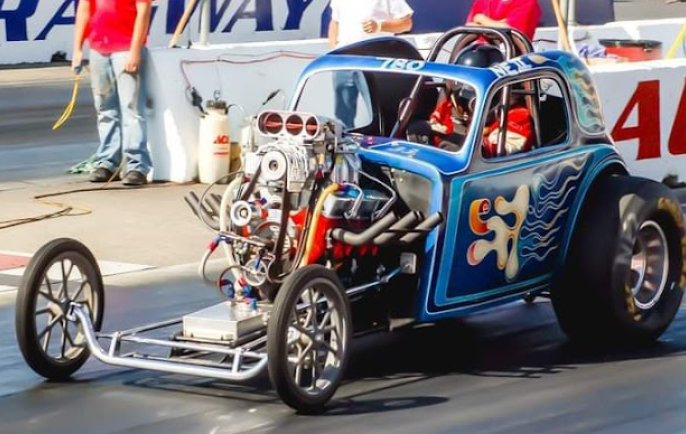
These days, Owens does most of his racing at the Mendota track in the Central Valley, where he climbs into a machine that looks more like a small rocket than a relic from the early 1950s. On the outside, it carries the shape of a 1951 Henry J — or at least the shell of one — wrapped around a purpose-built tubular frame drag structure.

Ed Owens (center) is pictured with his Henry J dragster, with a team member and track official in Mendota. (Submitted Photo)
“This was a car built by Kaiser Steel in 1949. It was a real economical car and at one time was sold at Sears and Roebuck, I think for around $800,” Owens recalled. “Eventually they were trying to give them away. Mine is a metal shell over a tubular chassis.”
The young enthusiast first raced in Texas, staying with the sport until he was 17. After a four-year stint in the U.S. Marines, he shifted into stock cars for a dozen years before eventually finding his way back to drag racing, returning to the straight-line speed that had captured him as a boy.
Owens says he did much of the work on the Henry J himself after buying the car out of Kentucky through his friend Eddie Montoya. Like many race cars, it carries the fingerprints of the person who drives it — adjusted, tuned and understood through hours of hands-on work. “I do most of the work myself, and this takes off at about 5,000 rpm,” Owens said.
After taking the last month off, Owens is preparing to return next month to Mendota, where the eighth-mile track has become familiar ground and where he is leading in points. The shorter trip is part of the appeal. “I can run there and not stay overnight. If I do, I gotta stay in a tent,” Owens said.
He has won five events at Mendota over the past five years, and the next race carries extra weight: it is the finals. When the moment comes, Owens will climb into a 700-horsepower rocket that weighs just 2,300 pounds with him in the driver’s seat, a compact and violent machine built to leave hard and run fast.
His cheering section is usually a family affair, led by his youngest daughter and her two sons. The racing bloodline may not end with him. “She’s getting started trying to drive too,” Owens said.
For Owens, the draw remains as simple as it is enduring: the competition, the work, the people and the sense of belonging that comes with showing up at the track. “I’ve always loved doing it. I love the competition and I just hang out and do my thing. I love the people, the people make the difference, and they’re really what it’s all about,” Owens said.
Anyone who is familiar with even an ounce of Mariposa County’s extensive history has likely heard of Gary and Bill Williams, the Williams brothers whose long-running racing partnership became part of the county’s drag-racing lore. Known for campaigning a 1965 Ford Falcon in NHRA Super Stock competition, Gary Williams of Mariposa was still appearing in national event qualifying lists decades after the brothers first began making their name, including a 2001 Super Stock qualifying session at Sonoma in which he topped the opening order in SS/MA.
Multiple racing references describe Gary and Bill Williams as having raced the multi-time national-record-holding Falcon for nearly five decades, a span that made the Williams Brothers team a touchstone for younger Mariposa racers who grew up around their example.
Gary Williams, a third-generation Mariposa resident, can trace the start of it all to the day he turned 16. That was when he bought his mother’s 1949 Ford, drove it to the Ballico drag strip and entered his first race. A month later, he was back — and this time he came home with his first trophy. “I bought my mom’s 1949 Ford the day I turned 16, took it to the Ballico drag strip and entered my first drag race. A month later I did it again and picked up my first trophy,” Gary shared.
His first new car was a Ford Galaxie powered by a 406, a machine he raced and still drove to work. For a time, he and a friend from CDF — the California Department of Forestry — looked toward even faster possibilities after buying a dragster from racing brothers in Madera. But life intervened before the project could take shape. “Then he started having babies, so that kind of put an end to it,” Gary explained.
The car that would come to define the Williams name came next. Gary traded the Galaxie for a 1965 Ford Falcon and began building a reputation with it. In 1966, he said, it ran as an ARHA car; by 1968, he was unbeaten in his class. “I won about 20 trophies in that car,” he continued.
The Falcon soon became known well beyond Mariposa. By 1969, Williams said, its reputation had reached Ford Motor Company, which invited him into its racing program. He left CDF and moved to Michigan, where he managed Ford’s Total Performance show from 1969 to 1972 and found himself traveling to some of the biggest stages in motorsports — from the Indy 500 to major drag and Trans Am races, and even two weeks at the Mint 400 with Parnelli Jones. Looking back, Williams summed up that stretch of his life simply: “I was pretty damn lucky.”
In 1971, Williams teamed with his friend Jim Forga, whom he described as a remarkable engine builder. Together they built the California Colt and campaigned it for three years, drawing attention for the kind of small-block performance that racers remember. “We got written up for having the quickest and fastest 289 in the nation for a couple of years, like 1970 to 1972,” Williams said. Other than machine-shop work in Modesto, he added, the cars were largely the product of their own hands.
Those early years also carried the support of a small-town racing network. When NAPA moved into Mariposa, Williams said, the store sponsored his parts, while Mariposa Chevron and the Fish Camp service station helped keep him in gas — the kind of local backing that made a long racing life possible.
The spark, however, had been struck even earlier. At 13, home sick with the flu, Williams said his mother brought him copies of Hop Up and Motor Trend. The magazines opened a door. “That lit my fire in interest to cars,” he said. By 14, he had talked her into taking him to the drag races in Madera.
Williams has not raced since the Covid-19 pandemic, when events were cancelled and the rhythm of the sport was interrupted. He made a couple of runs afterward, but age and the cost of travel have made regular racing harder to justify. “They cancelled all the drag races. I ran a couple of races after that but I’m getting too old. I couldn’t afford the gas to get there now,” he said.
The Williams Brothers’ fame and success reached well beyond Mariposa, helping light the same spark in Gary Hardee, a Cressey resident with long-standing ties and close friendships throughout Mariposa County.
Hardee’s own path to the drag strip began after his father retired from the Air Force and the family moved to Lake McClure. In high school, already interested in cars, he picked up a copy of Super Stock magazine his mother had bought for him. One article was enough to send him toward Mariposa, where he sought out Jim Forga and Gary Williams. “I read the article and went up to Mariposa to meet Jim Forga and Gary Williams,” Hardee said. “They were super nice guys, and instead of just running around the streets and drag racing I decided I needed to do that in my own car and be safe about it. They were Ford guys, and so was I, so I had Jim build me an engine for my 1974 Pinto. That’s what started it all.”
That 1974 Pinto remains the centerpiece of Hardee’s racing life. Today it runs in D Gas, indexed at 10.6 seconds and reaching about 130 mph. Much of the car carries his own labor and the lessons he learned early on in Merced, working at a shop owned by Dick Klieman, another Mariposa connection who helped shape his mechanical education. “I did most of the building on this car,” Hardee said. “I worked for a shop in Merced that was owned by Dick Klieman who was from Mariposa. I kind of learned everything from him in my early life. I learned how to build automatic transmissions from him.”

Gary Hardee with his 1974 Pinto and trophy. (Submitted Photo)
From there, Hardee kept learning by doing, troubleshooting, rebuilding and eventually becoming the kind of racer others trusted with their own equipment. “I bought an auto trans and it wasn’t working so I kind of figured it out, so I eventually taught myself,” Hardee said. “I built a couple for Gary, and I knew Billy Williams, his younger brother, really well.”
Hardee was back at Bakersfield a couple of months ago, where he opened the season by winning the first race of the year. In the second race, he advanced through three rounds, giving him hope that he can hold onto the top spot in his class.
For Hardee, now 71, as for so many in Mariposa’s racing circle, the prize money is not what keeps him loading up and heading back to the strip. The draw is the people: racers from every walk of life who compete hard, help freely and turn race weekends into something close to a reunion. “It’s certainly not the money that drives me to compete,” Hardee said. “It’s a great group of people to be with. If you have issues, they’ll always help you out, and they’re from all walks of life. There are doctors, lawyers, mechanics, whatever, and it’s almost like a family, everybody knows everybody.”
Ken Gillispie has called Mariposa County home for the past five years, but his roots here reach back much farther. These days, he has stepped away from climbing into race cars himself — a shift that may be good news for the racers who depend on the rare craft of a skilled engine and chassis builder.
“I’ve been up here off and on for the last 25 years. I used to come up and help my dad at his property on Triangle Road,” Gillispie said. After relocating from Southern California, he bought 10 acres on Triangle Road and is now building the shop he expects to have open around November.
Gillispie describes himself simply as a chassis builder who does custom fabrication, but that modest description hardly captures the reach of his work. Over the years, he has earned a reputation as a race-engine builder whose skills have extended beyond dragsters to motorcycles, boats and even pylon racing aircraft.
“I have people bring their engines up here for me to rebuild,” he said. His work has drawn attention from Hot Rod Magazine and other publications in the speed world, but since moving to Mariposa, Gillispie has put competition aside and focused on helping others go faster. “I haven’t competed in a race since I moved up here. Mainly I’ve been helping Ed (Owens),” Gillispie explained. “I would rather build them than race them — it’s cheaper.”
When he was still the one behind the wheel, Gillispie was running with “the big dogs” — altered fuel cars, funny cars and front-engine fuel dragsters burning nitro. Compared with that level of racing, he said, the local scene is a little more relaxed. “Up here we’re just playing around with alcohol,” he added.

Ken Gillispie is pictured in his car during a 2009 ANRA drag competition.
His background includes the kind of machinery that sounds almost unbelievable until he explains it plainly. “We typically ran front-engine dragsters. We’ve got a funny car we took the body off and put on a plastic replica 1923 T body,” Gillispie said. The car runs in nostalgia racing, is indexed at 7.0, can compete in modern NHRA events and, he said, can leap from zero to 100 mph in about a second. Along the way, he has even lined up against Dave Lawson on the track.
For Gillispie, the work has never been far removed from childhood. “I grew up around this. As a kid I went to every racetrack I could and then it just took off from there,” he said. “I started building cars and then it went to race cars. Now instead of racing I’m building hot rods and classic cars.”
Across Mariposa County, that is the thread running through the whole story: not simply horsepower, trophies or elapsed times, but the people who keep showing up for one another. From veteran racers to late-blooming competitors, from builders in quiet shops to families waiting near the fence, the drag strip has become a gathering place where craft, memory and friendship move as powerfully as any car leaving the line.
Comments