Bound by speed: Mariposa’s drag racers find family at the strip
By Dan Tucker
Across the broad, sun-washed sweep of Mariposa County, where quiet roads curl through rugged hills and open ranchland, a familiar rhythm rises from the landscape: the deep, rolling thrum of a loping V8 engine. In this sprawling, sparsely populated corner of central California, a devoted band of residents shares a restless affection for horsepower, open pavement and the enduring “need for speed.”
They come from across Mariposa County and beyond its borders — old-timers, newcomers and weekend regulars drawn by the same rumbling call. What keeps them returning to the drag strip is not simply the lure of prize money or the shine of a trophy, but the bond formed in the pits, where drivers, engine builders, crew members and fans trade advice, lend tools, share stories and stand together under the common banner of speed and brotherhood.
Possibly the two highest profile drag racers within this embracing collective are George Thomas and Dave Lawson.
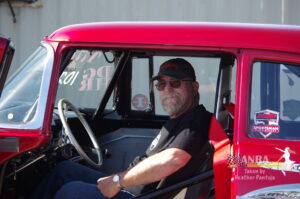
George Thomas behind the wheel of the Mariposa Missle. (Submitted Photo)
For Thomas, who owns and operates Mariposa Auto Body on Ben Hur Road, the pull of speed began long before he settled into the rhythms of life in Mariposa. As a high school student in the Bay Area, he found himself drawn to the roar, risk and ritual of Friday nights at Fremont Raceway.
“My wife and I went to the same high school, and I was racing at the Fremont Raceway,” Thomas recalled. “We used to go every Friday night, and then we started raising a family and kids. I did a lot of car show stuff and built cars for other people. I was Dave’s crew chief and raced his 1956 Chevy Wagon and 1970 Javelin for around 12 years, while he was driving his rail.”
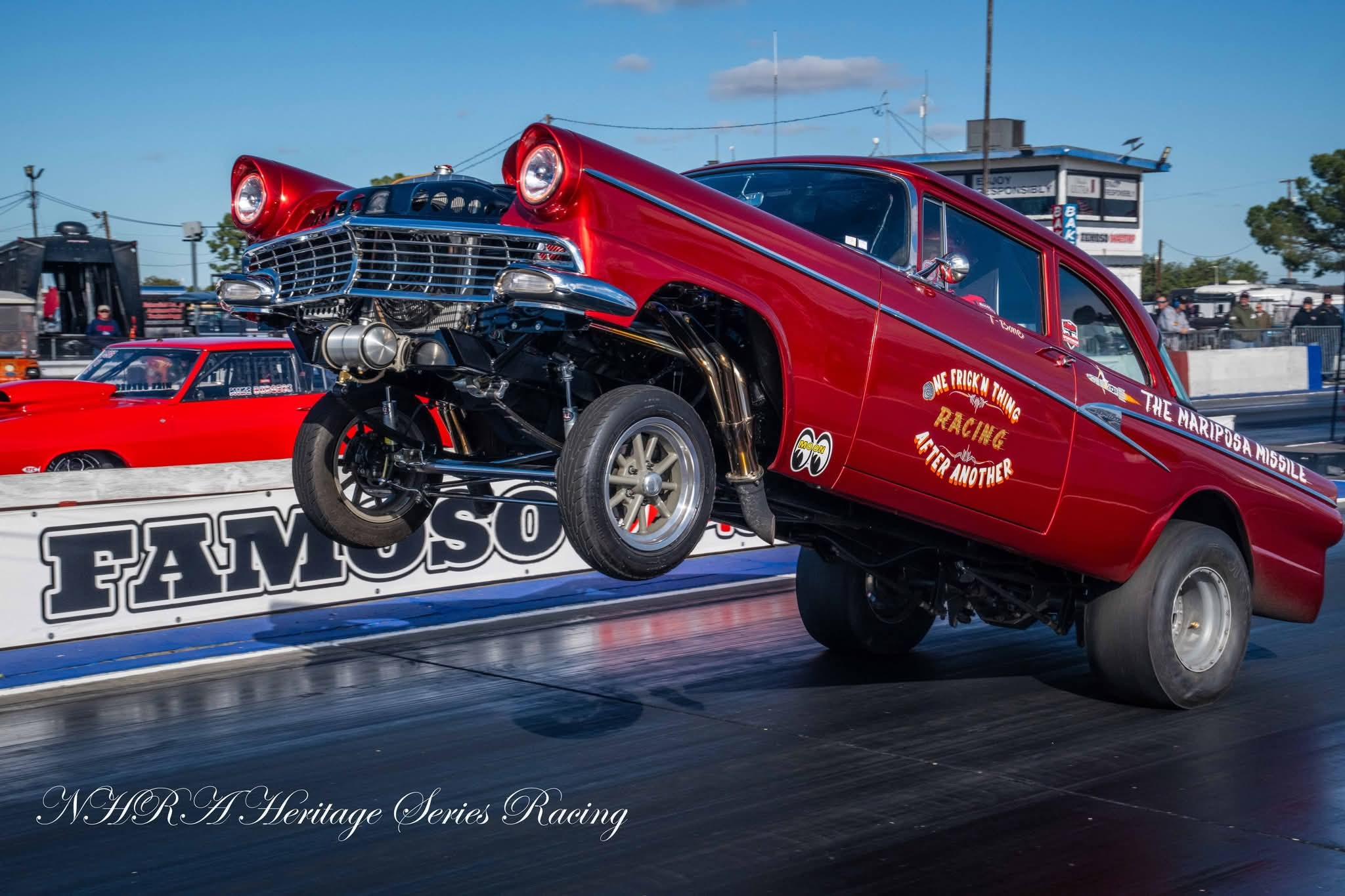
Known affectionately in drag racing circles as T-Bone, Thomas has called Mariposa home for 37 years. These days, he pilots the Mariposa Missile, a 1956 Ford that for the past three years has competed in a nostalgia drag class built around the cars, character and mechanical spirit of the 1960s and 1970s, with an intricate indexed system guiding the competition. He also runs in the wide-open Hot Rod division that offers a winner-take-all competition.
The Ford is considered a “gasser,” a term Thomas explains with the plainspoken precision of someone who has spent years around race cars. “A gasser is a jalopy with a straight axle,” he said. “I basically built this car from scratch. I got the shell and started from there.”
For Thomas, the reward has never been measured in prize money. He laughs at the economics of the sport, repeating a line his wife coined to capture the expensive devotion required to keep racing. “You can make a small fortune in drag racing,” she tells him, “if you start with a large one.”
What draws him back is something harder to count and easier to feel — the fellowship that forms around the starting line and in the pits. “The racetrack is my church,” Thomas said. “They’re all good people. I could lose anything from a lug nut to a carb and anybody would give you one. It’s only when you face off at the line that you’re mortal enemies. It’s like a family away from home.”
When Thomas eases the Mariposa Missile toward the starting line, the race is rarely his alone. His wife, Pamela, is part of the steady support system around him, his granddaughter is often there to cheer him on, and his daughter, Ginger, has become one of the most reliable members of his crew. “My granddaughter is always cheering me on,” Thomas said. “My daughter Ginger is more help on the crew than just about anybody.”
Earlier this month at Samoa Raceway on the peninsula near Eureka, he spent five cool days competing in the D Gas class. In sea-level air that never climbed past 64 degrees, the 1956 Ford delivered its strongest quarter-mile run yet, covering the distance in 10.17 seconds. There was no prize money at the finish, and the round-trip cost nearly $1,200 in motor-home fuel at today’s prices, but Thomas came home with a trophy, a faster car and the kind of memory that helps explain why, after all these years, the sport still has its hold on him.
Dave Lawson, who has operated Lawson Construction as a general contractor in Mariposa for decades, occupies a storied place in the local drag racing scene. Without the fanfare his record might suggest, Lawson has quietly assembled a remarkable run of success, claiming five national championships in the past seven years behind the wheel of his lightning-quick Nostalgia Eliminator I rail. He’s also collected eight Wallys over the past five or six years, although he hasn’t pounded the pedal in the last two seasons.
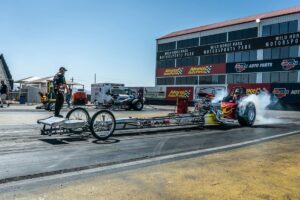
Dave Lawson lights up his rail at the Wild Horse Pass Motorsports Park. (Submitted Photo)
Lawson won his first national title in 2016. The 2016 trophy was in the American National Racing Association (ANRA), which he won again in 2020. Interspersed between those crowns were championships from the National Hot Rod Association in 2017, 2019, and 2021.
To understand the scale of that achievement, imagine being strapped into a long, low machine wrapped around a massive engine and a strong but slender frame, then launching down the quarter mile in 7.6 seconds at 185 mph. In less than two seconds, the car can surge past 100 mph — a violent, breath-catching burst of acceleration that turns open pavement into a blur and reveals why the thrill of speed continues to define the sport.
Lawson’s path to the drag strip began far from Mariposa. He was born in Vienna, Austria, the son of a Monterey language institute graduate who worked in counterintelligence — or, as Lawson puts it, “he was a spook.” Lawson arrived in Mariposa when he was 8, later graduating from Mariposa County High School, where the success of local racing legends Gary and Bill Williams helped spark an interest that would shape much of his life.
As a high school student, Lawson began tagging along with the Williams brothers to drag races. “I never really thought I would be a dragster pilot, but I found I really liked it,” Lawson explained. His first car was a 1956 Chevrolet “handyman” station wagon he bought in Hornitos for $150, then built up in auto shop at the local high school. Decades later, that same wagon remains part of the Lawson Racing stable.
The wagon has collected its own share of racing lore. It was the same Chevy Thomas was driving four years ago when the transmission imploded, a sudden mechanical failure that turned the run into a white-knuckle moment. According to Thomas, the breakdown “shoved the engine into the radiator and that’s what put the fire out. It was pucker time for sure, and I was doing almost 100.”
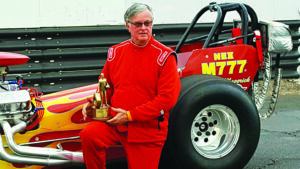
Dave Lawson is pictured with just one of the multiple Wally awards he’s captured during his remarkable drag racing career. (Submitted photo)
Now Lawson is preparing to send the wagon back down the strip before the end of the year. Its rebuilt engine is nearly complete, and he also plans to return with the Javelin. “I’m going to run the wagon again in the Hot Rod division, not in the indexed class. It will have 890 horsepower and run in the 9s as a 4,000-pound car,” Lawson explained.
“With your hair on fire, it’s pretty exciting,”
For Lawson, the machinery and the numbers tell only part of the story. The real pull is the rush of speed and the people who gather around it. “I’m a confessed speed freak,” Lawson said. “When you’re going 176 miles per hour with your hair on fire, it’s pretty exciting, but it’s also the friendships and camaraderie that keep me locked in. It’s absolutely amazing — if you break something in the pits there’s always someone who will step up.”
Chris Robbins, who has lived in Mariposa since 1997, discovered the pull of speed early. Long before he was making official passes down a drag strip, he was testing the limits in the informal world of street racing. “I started playing around, street racing when I was a kid, but I got my license to race in professionally 2011,” Robbins explained.
Today, Robbins races one of the most unlikely machines likely to appear in the staging lanes: a 1967 Ford Econoline pickup. The truck began as a workhorse, not a race car. “It was a truck that my dad bought from Macdonald Douglas with 18,000 miles on it in 1980 for his ranch. When he passed, he gave it to one of his good friends. He gave it back to me and I turned it into a drag racing vehicle,” Robbins detailed. “All my friends and family members who have passed are listed on the truck. I just got it on the track in 2023.”
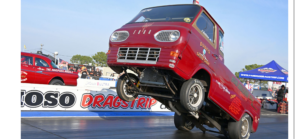
Chris Robbins does a wheelie in his 1967 Ford Econoline. (Submitted Photo)
Robbins runs the Econoline in the Hot Rod division (a combination of all the classes), where competitors are launched at staggered intervals by the starting lights racers know as the Christmas tree. The stagger is designed to balance the race according to previous elapsed times, or ETs. In 2012, Robbins also bought a 1964 Ford Fairlane already built as a dragster; he said he ran the Fairlane in C Class, where it was indexed at 9.60.
For Robbins, both vehicles carry the imprint of his own hands. “I built the entire Econoline,” Robbins added. “I had to rebuild some of the Fairlane this year, so I replaced a lot of stuff like the interior and the paint.” Together, they reflect the same blend of memory, mechanics and speed that runs through Mariposa’s drag racing community.
Robbins has not made a pass since April, but he is already looking toward October, when he plans to return to the strip at Bakersfield for the final leg of the NHRA Heritage Series. His most recent trophy came about a year ago at Sonoma Raceway in a West Coast drag race. Before that, he said with a touch of perspective, “it’s been a while.”
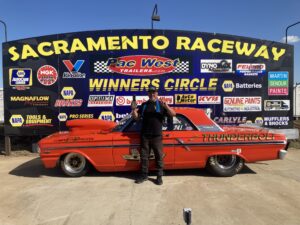
Chris Robbins is pictured with one of his trophies won in his 1864 Ford Fairlane. (Submitted Photo)
When he does return, Robbins will not be making the journey alone. Like others in Mariposa’s drag racing brotherhood, he carries the support of family with him, with his wife, mother and daughter often there to cheer from the sidelines.
What keeps him coming back is the same force that first drew him in — the charged stillness before the lights drop, the jolt of acceleration and the fellowship waiting at the end of the run. “It’s the adrenaline rush at the starting line,” Robbins said, describing the driving force that keeps him competing. “I go out there for fun, but sometimes you get upset when you go out in the first round, but it’s all about fun with friends and family. Yes, I’m competitive, but everybody in racing is my friend.”
A relative newcomer to the sport is Rich Strickfaden, a local contractor who owns Accell Drywall, Inc. in Mariposa. At first, he thought drag racing was simply a matter of outrunning the car in the next lane. It did not take long for him to discover that the quarter mile was only the beginning of a far more demanding education in precision, patience and competition.
Strickfaden came to Mariposa in 1977, but his life at the drag strip began only five years ago.
The invitation came through Robbins, who helped steer him toward the car that would start it all. “Chris Robbins is the guy who got me started. He found my car, I bought it and trailered it home, he kind of talked me into it,” Strickfaden remembered.
Now Strickfaden sends his 1973 Camaro down the track in the indexed 10.6 class, a category built around vintage muscle and old-school power. “These gassers are all old vintage muscle cars, 1974 and older. There are no power adders, they have to be naturally aspirated with carburetors, and there’s no nitrous or turbos, it’s all old school,” Stickfaden outlined.
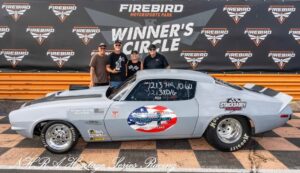
Rich Strickfaden is pictured with his first-ever Wally, claimed in a drag race at Firebird Motorsports Park in Arizona. Left is is his brother Ken, his wife Randa is next to him, and a raceway official is at the right. (Submitted Photo)
The class rewards consistency as much as raw horsepower. “All these indexes are only separated by a second, it’s the best time you’ve ever run, and you can’t finish going any faster than that. I run a 10.6 index and just race people in my class. That allows for a guy who can financially only build a 10.6 car to compete,” he added.
The learning curve was steep enough to make him wonder whether he belonged at all. “I went a whole year thinking I would never win a race. When I first got into this, I thought it was going to be easy, but after a whole year of racing I decided I was in over my head. But time goes on and you start learning. Dave (Lawson) and George (Thomas) got me through the growing pain and now I’m hitting that 10.6,” Stickfaden said.
In indexed racing, that precision can decide everything. If a car “breaks out” by running faster than its index, the driver can lose even after reaching the finish line first, allowing the car that crosses second to take the win. “It’s very technical,” he clarified.
Much of Strickfaden’s Camaro carries his own workmanship, with help from friends who know the demands of the sport. “Bill Fleming built my motor, and another racing buddy built my transmission,” Rich said. In that way, the car reflects more than one racer’s ambition; it carries the shared knowledge, generosity and hands-on devotion that keep Mariposa’s drag racing circle moving from one run to the next.
Strickfaden checked a major goal off his bucket list in Chandler, Ariz., when he won his first Wally, the coveted NHRA trophy that carries special meaning in the sport. “I run in two divisions in the NHRA (National Hot Rod Association) Heritage Series. It’s a nostalgia eight-race series. I won in Chandler by six 1,000ths of a second. NHRA has been doing this for 75 years, so this is the diamond anniversary. The the Wally award this year is silver and you can only win it this year. They’re usually gold colored,” he explained.
At Chandler, he entered both the 10.6 indexed class and Hot Rod division and won them both, turning the steep learning curve that once humbled him into a breakthrough weekend. For a racer who once doubted whether he could win at all, the double victory suggested that experience, patience and a well-sorted Camaro had finally caught up with his ambition.
Rich’s wife Randa, and his brother Ken, also once an ambitious drag racer, usually accompany him to the drag strips.
For Strickfaden, the appeal is rooted in the satisfaction of building something with his own hands and then feeling it come alive at speed. “I’ve worked hard all my life. Some people go out and buy a Harley, I went out and got a race car. It’s just the fun and exhilaration of building a car and racing it that drives me, and the great friendships you make on the way,” Stickfaden proclaimed.
The sport also gave him a memorable family rivalry. “When I got my car, my brother’s dream had always been a big block Nova, and he finally got one. He had a nine second car and our first race was against each other; it was so comical. We had a quarter bet on it, and that quarter is still framed,” Stickfaden added.
His brother Ken, a 1982 graduate of Mariposa County High School, said his 1969 Chevy Nova was built before Rich’s Camaro, but he held off on taking it to the track until the two brothers could make the trip together and line up side by side.
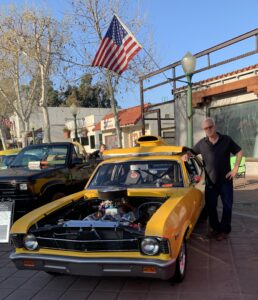
Ken Strickfaden is shown with his 1969 Chevy Nova. (Submitted Photo)
Ken’s Nova was a 9.6-indexed car that he ran in the C Gas and Hot Rod divisions, capable of reaching 140 mph. But Ken measured the experience with a racer’s blunt humor. “I never won sh__.” For the past 26 years, he has raced out of Anaheim, often meeting his brother at Famosa Raceway in Bakersfield.
In 2023, health problems forced Ken to hang up his racing gloves. Rheumatoid arthritis now requires injections, and the heat, fire suit and safety equipment demanded by his class became too much to manage.
Still, Ken has not left the sport behind. “Now I’m crew chief for my brother, and I have a knack for electrical issues, so I help out other guys up here,” Ken said. He recently moved into his home in Ahwahnee.
For Ken, racing was never only about trophies. It was about fulfilling a long-held wish and feeling the force of a car built to lift and launch. “I really didn’t have any motivation to get into the sport other than just a bucket list check off. I always wanted a car that would do a wheely, a 10-second car, and then I got a 9 second car, plus my NHRA competition license. I didn’t really care if I won or anything,” he explained.
WATCH FOR PART TWO OF THIS STORY TOMORROW MORNING! Right here on TheMariposan.com.
Comments