
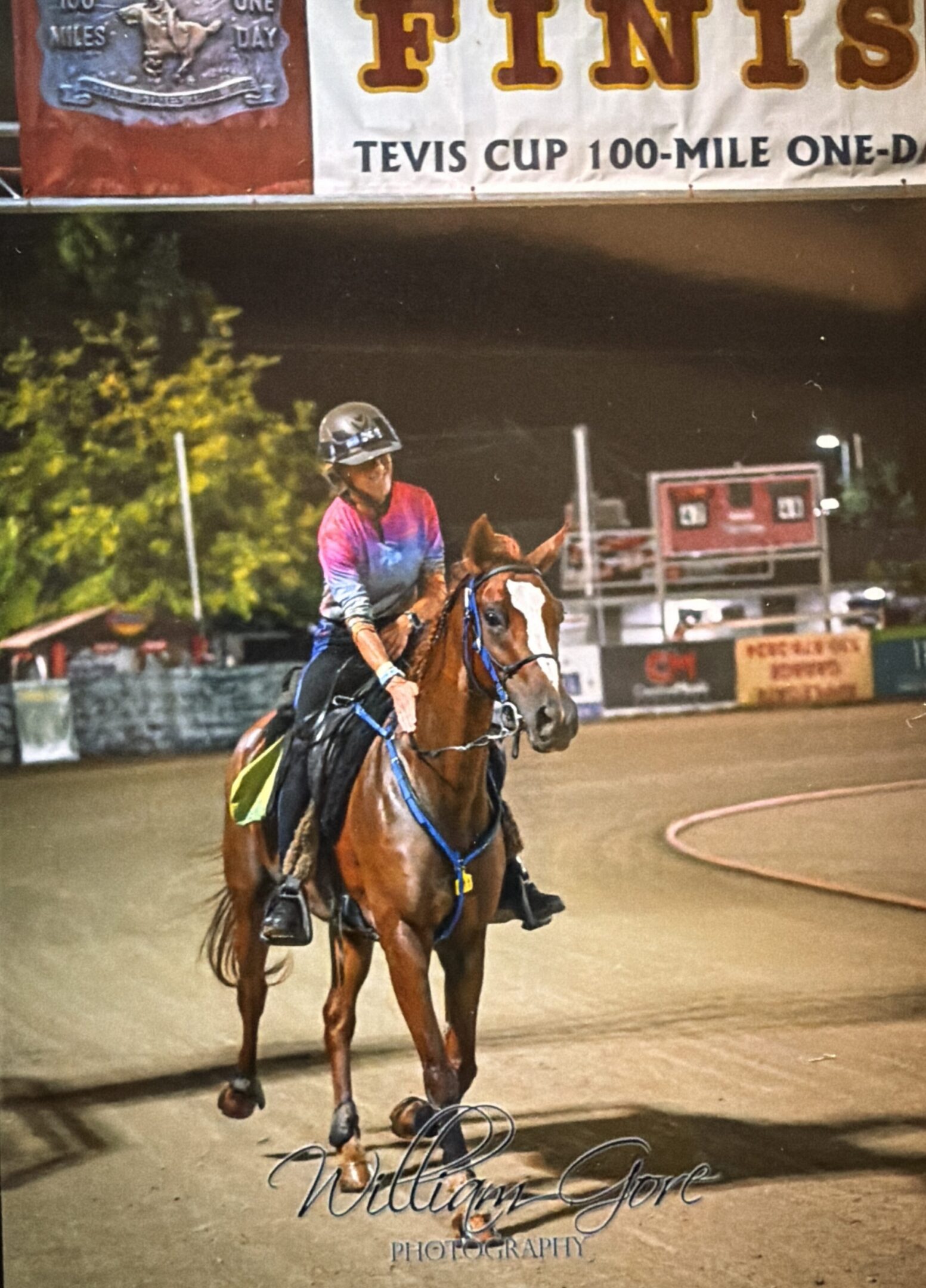
Mariposa’s Dr. ‘Jay’ measures courage in hoofbeats
By Dan Tucker
There are people who chase the edges of human endurance because something deep within them will not let them stand still. Some climb Mount Everest, where one misstep can mean the difference between triumph and tragedy. Others set their sights on the far blue emptiness of the Pacific, sailing alone from the continental United States toward Hawaii with little more than skill, nerve and faith to carry them across.
And then there are those who measure courage in hoofbeats — 100 punishing miles through the rugged high Sierra, where horse and rider push through dust, darkness, heat and exhaustion in a race not only against the clock and other competitors, but against the limits of their own abilities.
For Mariposa’s Dr. Jeanette Mero, known warmly to nearly everyone as “Dr. Jay,” that challenge is not a once-in-a-lifetime feat. It is a calling she returns to year after year — and one she has met with remarkable success. Her mountain to climb or ocean to cross is the Western States Trail ride, a 100-mile one day challenge for riders and horses from Lake Tahoe on the eastern side of the Sierra to Auburn.
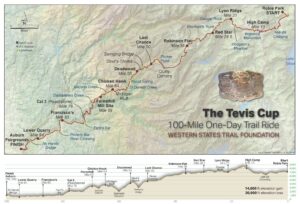
This is a map of the grueling Tevis Cup 100-mile endurance race over the Sierra. (File photo)
Only half of the riders and horses that enter the Tevis Cup race every year actually are able to complete the course. This completion rate has been consistent since the event began in 1955. The race has been held every year since then, except for a few cancellations due to wildfires and the Covid-19 pandemic.
Dr. Jay has entered the Tevis 12 times, completing the competition eight times. The crown jewel of her effort is the Tevis Cup she captured in 2024. She has also finished four times in the top ten with a fourth, sixth, eighth and a tenth-place finish. On top of that she claimed the sought after Haggin Cup in 2021 which is awarded to the top ten finisher who’s horse is in the best condition. Her daughter Reyna also won the Haggin Cup in 2024. “So, we have done well, we’ve got three cups in house in the past five years,” Mero said
In this year’s race Mero finished fourth, crossing the finish line at the same time as the third-place winner, Mollie Quiroz. Both stepped through the banner at five minutes after midnight. “I could have challenged but Mollie is younger and a great kid. Her horse suffered a catastrophic injury not too long ago, so I didn’t feel the need, and was just happy for her and her horse, who wasn’t in great shape when she finished the race, but was alright. My young mare still had plenty in the tank, but we rode together about the last 70 miles, and that was special,” Dr. Jay explained.
Just before this year’s Tevis challenge on Aug. 1, The Mariposan sent Mero a list of questions, primarily about her motivation for competing in what likely the world’s toughest endurance race is.
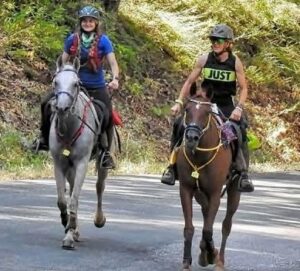
Reyna Mero (left) and her mother Dr. ‘Jay’ Mero are pictured at a recent Tevis Cup race. (Submitted photo)
Those questions and Dr. Mero’s answer follow:
Question 1. Most people know that the Tevis is a grueling test for both horse and rider. What is your motivation to compete at this elite level and how many times have you entered?
Mero’s response: “I am a person who thrives on pushing myself to overcome whatever obstacles are in my way. I spend a lot of time training – either running or riding all by myself, alone in my own head. Every workout I try to push myself to either ignore the associated pain and discomfort, and to at least maintain the effort, or better yet push myself a little bit more. That’s my base personality, always giving 110% in whatever I do, no matter how small a task or project. I was always that way and as an athlete when I was younger in high school and college.
When I was an intern in Canada the year after I graduated from vet school (1994/95), I was introduced to the sport of endurance riding. I did not know it even existed. I was immediately hooked and enthralled, as I had already been souring on show competitions I had been involved in with both dogs and horses. Here was a sport that I would literally live and die by my own hand, by my own efforts – and not by someone else’s subjective opinion. It was perfect for me.
Now looking back 20-30 years, it is kind of remarkable to see that I have basically dedicated my life to this sport, not only as a competitor but volunteering for over 20 years as well. Luckily, I have been able to excel at the highest levels.
There seems to be two kinds of Tevis riders – those that want to just get the buckle and say they did it and are content, and people like me that make it a nearly religious or spiritual pilgrimage every summer, trying to complete as many times as we can.
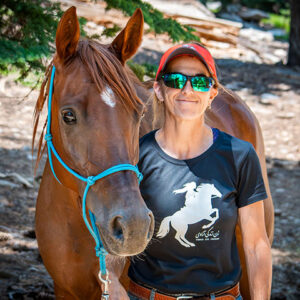
A proud Dr. ‘Jay’ Mero is pictured after capturing the coveted Tevis Cup in 2024. (File photo)
Tevis is just magical. Yes, it’s pretty damn hard, but that’s part of it too – that challenge. But there is something about starting in the dark, and then within an hour you can watch the sunrise over the high country while being in my favorite place – on horseback.
Then there is the piece that is a partnership with your horse. To be successful, especially at the highest levels, you and your horse must have a true partnership and cooperation. To ask a horse to do that tough of a ride, at the elite level of speed and effort means you really have to be in tune with every little attitude and change in your horse.
You are responsible for safeguarding their health and wellbeing and you sure as heck are not going to get a horse to do that effort without the horse “wanting” to do it right there with you. These animals are remarkable, and my best horses have as much will and drive to work hard as I do. It’s something I think the animal rights people will never understand – you cannot make or beat a horse into these long rides, the horse has the ultimate say and the ultimate want to and many of them just love their jobs. Truly.”
Question 2: I believe you have two children (or maybe more) who have or are competing. Can you share information about their entries and finishes in the Tevis?
Mero’s response: “Reyna has ridden it eight times and has finished five. She has two top tens – a second and a seventh. She is turning 25 in Sept., and she rode her first Tevis as a junior. She is about to start her third year in veterinary school at Washington State Veterinary School.
Tristan will be turning 29 at the end of this month. He is working in the mental health industry with a master’s in clinical psychology in Fresno.
Tristan has one buckle (completion) from his first attempt in 2017. He has two starts; he was pulled in 2023.
One thing I will say though is Tevis is a full family affair. -My other two children, Emma my youngest, is starting her third year at Cal Poly and intends to teach Ag. She also started young in endurance and then moved over into riding quarter horses and she has her own mare and does team penning and sorting.
Elaina, my oldest daughter, is a prosecutor in the Fresno County District Attorney’s office. She rode a bit when she was very young but spent more time than any of them in competitive travel sports, especially softball.
Whoever is not riding is crewing for Tevis. I could not get the results I get without having the huge support of my children crewing and supporting us. So, every summer now for the last ten-plus years, everyone plans their summer around when Tevis is. It makes my heart smile to have it be a whole family affair.”
Question 3: Since the Tevis is a test for both horse and rider, how do you prepare your horse, or horses?
Mero’s response: “I had intended the last two years to compete again on my mare, Ozark Kaolena SWA (Lena) and to give it a solid competitive try again. Both years the mare had been doing well and then in the last week or weeks lead up to the race had trouble.
Last summer it was a bruise to the right rear hoof. This year she had some muscle issues in the last month, and then when I got that solved, she went lame again on her right front. Lena has four Tevis finishes out of five attempts (three in the top ten). She has the Tevis Cup win in 2024 and a Haggin Cup win in 2021. She has nearly 3,500 endurance miles and this is her eighth season. She is highly decorated mare, winning many rides and other coveted ‘Best Condition’ awards
She has done this in spite of hoof conformation and issues that should have rendered her useless for our sport. She was raced on the track for several years before I purchased her in Texas in 2018. So, it has been a balancing act of keeping her sound and using corrective shoeing and attempts with all different kinds of shoe products and methods.
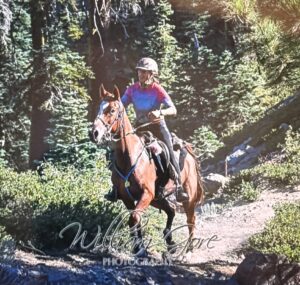
Dr. ‘Jay’ Mero is pictured on the trail during this year’s Tevis Cup endurance race. (Submitted photo)
And even when we think we finally have it all dialed in, she can still struggle, almost always with her right front. I am hopeful we can spend this next year getting ready for Tevis in 2027 for one last, big competitive effort. But I am well aware at some point the wear and tear of the miles and years, and the feet struggles will force her into retirement.
The last two years I have had to use my younger mare I have been developing. I bred her myself, which is big deal to have made the breeding decisions and then raised her and trained her and prepared her all myself.
She is now seven years old. Her name is Okbas Jet Set Arrya. Arrya for short. She is also an Arabian (which is all we ride) and she has what we call “race bred” breeding, both parents having been raced on the track. Her mother was an accomplished endurance horse for me that did her own first Tevis in 2017.
I took Arrya last year, but she way too young. Do not do this attempt type of situation with a six year old – and we were successful with a 12th place finish – which was not intended or expected. I just rode the mare through the day using what she wanted to give me. And very carefully protecting her health and welfare by controlling our speed and effort.
This year as a seven year old we now had three years under the saddle, and two years of heavy endurance training and competition with at least 900 miles of endurance competition already completed.
So, when I had to take her again I knew we had more we could work with. All I was hoping for was an improvement on the 12th place from last year. I had no idea the mare was going to be able to pull off a 4th place finish, and better her time from last year by two hours.
I had people ask me why I didn’t push her more since for a while we were close to the leaders, to which the I answered, these are still the building years for a young, talented horse, and asking too much effort too soon, can either lead to severe, career ending injuries or souring the horse on the sport.
It takes well over three years to prepare a horse for tough competitive effort and we normally say it takes three years to “build a 100 horse” and even attempt a 100-miler. There is world of difference between just finishing a 100-miler and being highly competitive. So, I am still in the building process with Arrya and do not expect to ask “bigger things” of her, like a potential run for the win, not for at least a few years yet.
As far as training and conditioning, honestly that’s pretty simple. It is years and years of ‘LSD,’ just like in human distance events, ‘Long Slow Distance’ as the initial building blocks.”
Dr. Mero has now been practicing in Mariposa County for the last 20 years as Mariposa Equine Services. She started her own practice in August 2006, after working with Dr. Eileen Wise for about ten months. She then headed off into a large animal, predominantly equine only, practice on her own.
Comments